

Most investors lose money quietly - not dramatically
NOI doesn’t collapse overnight.
It erodes through small operational decisions most models never stress-test.
This guide walks through 10 operational realities that quietly impact income, expenses, and asset value - long before they show up in a pitch deck.
This guide is for you if:

You are deploying six or seven figures into commercial real estate and want to understand where small assumptions create large downside..

You review sponsor decks but want to see what is happening beneath the narrative.

You rely on financial models but question whether the assumptions would survive real ownership pressure.

You want to understand how buildings actually make or lose money beyond surface level metrics.
This is not for passive income seekers. It is for investors who want sharper judgment before capital is committed.
Inside the PDF:
Most deals do not collapse dramatically. They erode quietly through small operating decisions that rarely get modeled properly.
By completing this program, you will:
- The most common ways NOI gets overstated
How “conservative” underwriting can quietly inflate net operating income without you realizing it. - Where operating expenses quietly drift
Not through dramatic mistakes — but through small, recurring assumptions that compound over time. Utilities, payroll, repairs, turnover, reserves — the line items that rarely explode, but steadily erode returns. - How lease structures impact real cash flow
Why gross, modified gross, and NNN leases aren’t just labels. You’ll see how fee structures, reimbursements, and escalations determine who actually carries risk when performance shifts. - Why CapEx timing decisions reshape returns more than rent growth ever will.
Capital expenditures don’t just affect the budget — they affect leverage, refinancing options, and exit timing. You’ll see how delaying or mis-sequencing improvements reshapes IRR in ways models often hide. - The small assumptions that create large downside risk
Vacancy buffers, renewal probabilities, bad debt, debt service coverage, reserve gaps — the subtle inputs that feel minor but become decisive when the market tightens.
These are the friction points operators see - but most investors don’t.
Get the Operator Checklist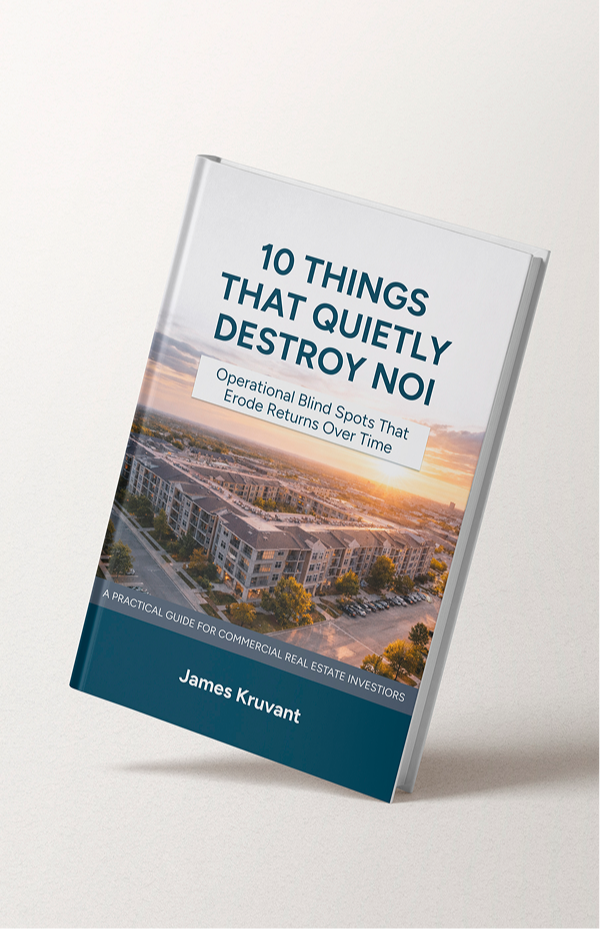

ABOUT THE AUTHOR
This guide was created by James Kruvant, a fourth-generation commercial real estate owner–operator with over 15 years of hands-on experience.
James has worked across the full lifecycle of CRE ownership:
- Acquisitions and Asset Management at an institutional firm with 27,000+ apartments and 13M+ SF of commercial real estate
- Principal-side asset management and redevelopment for a fourth-generation family portfolio — 1,000+ units and over a million SF of retail, office, and multifamily properties
- Co-GP and LP investor in development projects with his own capital
- Hands-on property and asset management across every major asset class
This isn't theory, it’s how capital is protected and grown through disciplined, multi-generational ownership.
MBA in Real Estate, NYU Stern School of Business BBA in Finance, Magna Cum Laude, George Washington University
This guide reflects the decisions James has had to defend under real ownership accountability, not theoretical underwriting exercises.
Before you wire capital,
understand what truly drives NOI
Download the guide and evaluate your next deal with sharper judgment.
Get the Operator Checklist
If This Changes How You See Deals
Download If these breakdowns shift how you evaluate risk and operating assumptions, the full program goes deeper into installing the operator lens behind them.the guide and evaluate your next deal with sharper judgment.
Get access to the full CRE Operator Academy here.
Learn More